Pro Mode Guide
Pro mode exposes every parameter of the tube circuit. Over thirty knobs across seven sections. This guide tells you which one to turn for the sound you want.
What sound do you want?
Start from one of these. Each combination produces a recognizable character. Every recipe matches a factory preset chip in the plugin's user-preset bar (tap it to load instantly), then fine-tune by ear. For a minimum-coloration starting point with no transformer, no aging, and a clean PSU, load the Super Clean chip.
Tube Amp Push
Snappy attack with audible sag on transients. The feel of a tube amp working hard. Best on drums, electric piano, bass, guitar bus.
- Tube12BH7
- Operating Point
- Plate V220 V
- Grid Bias−10.5 V
- Drive
- Input Gain0.70
- Interstage0.34
- Power Supply
- Rectifier R180 Ω
- Filter Cap50 µF
- Recovery13
- Transformer
- Xfmr70
- Tube Age
- Drift1.2
Liquid Presence
Open and effortless. Wide-open NFB, big cathode bypass, generous Mu Scale for a forward presence band. Best on lead vocal, acoustic guitar, full-mix sweetening.
- Tube6922
- Operating Point
- Plate V250 V
- Plate R200 kΩ
- Mu Scale2.5
- Drive
- Input Gain0.65
- Interstage0.50
- Circuit
- NFB0
- Coupling Cap0.068 µF
- Cathode Bypass70%
- Transformer
- Xfmr100
Velvet Bloom
Slight veil over the top, woolly mids, gentle THD that grows with level. High plate voltage with a heavy rectifier for that "old console" texture. Vocals, strings, acoustic.
- Tube12AX7
- Operating Point
- Plate V320 V
- Mu Scale1.5
- Power Supply
- Rectifier R150 Ω
- Filter Cap60 µF
- Recovery10
- Circuit
- NFB0
- Cathode Bypass55%
- Transformer
- Xfmr90
- OT Bass Phase85 Hz
- Tube Age
- Drift1.0
- Mu Loss1%
Cassette Glue
Compressed top end, narrow stereo, tiny coupling cap rolls off lows for a tape-machine feel without the wow/flutter.
- Tube12AU7
- Drive
- Input Gain0.60
- Interstage0.45
- Circuit
- Coupling Cap0.005 µF
- Cathode Bypass60%
- Power Supply
- Rectifier R80 Ω
- Filter Cap30 µF
- Recovery11
- Character
- Match18%
- Imaging22%
Crystal Air
Stereo expansion with deliberate L/R capacitance spread. Wide soundstage, airy top, and an extreme Mu Scale that lights up the harmonics.
- Tube6SN7
- Operating Point
- Plate V200 V
- Mu Scale5.0
- Character
- Match8%
- Imaging35%
- Crosstalk−60 dB
- Transformer
- Xfmr110
- OT Bass Phase60 Hz
- OT Phase3200 Hz
- OT Ph Q1.2
Mix Bus Glue
Just enough to gel the mix. Small amount of even-order harmonics, transformer hysteresis on transients only, no audible coloration in quiet passages.
- Tube6922
- Operating Point
- Plate V220 V
- Drive
- Input Gain0.40
- Circuit
- NFB0.06
- Cathode Bypass25%
- Power Supply
- Rectifier R15 Ω
- Filter Cap150 µF
- Transformer
- Xfmr30
- Character
- Match6%
Master Polish
Even gentler than Mix Bus Glue. Very stiff PSU, tiny iron lift, no spread or artifacts. The "barely there" pass for final masters.
- Tube6H30
- Operating Point
- Plate V250 V
- Plate R33 kΩ
- Drive
- Input Gain0.24
- Interstage0.20
- Power Supply
- Rectifier R8 Ω
- Filter Cap200 µF
- Reservoir560 µF
- Circuit
- NFB0.08
- Transformer
- Xfmr18
British Chime
AC30-flavored chime. High plate resistor, tiny coupling cap, no NFB. Best on guitar tracks or as a DI stage before a cab IR.
- Tube12AX7
- Operating Point
- Plate V275 V
- Plate R220 kΩ
- Mu Scale1.5
- Drive
- Input Gain0.40
- Power Supply
- Rectifier R120 Ω
- Filter Cap70 µF
- Circuit
- NFB0
- Coupling Cap0.01 µF
- Transformer
- Xfmr90
- OT Reso12 kHz
- OT Q1.3
Vocal Silk
Midrange focus with soft presence and clean tails. Modest NFB tames sibilance, cathode bypass adds low-mid weight. Best on lead vocals, dialogue, expressive solo instruments.
- Tube6SL7
- Operating Point
- Plate V250 V
- Mu Scale1.15
- Drive
- Input Gain0.45
- Interstage0.32
- Circuit
- NFB0.025
- Coupling Cap0.047 µF
- Cathode Bypass38%
- Transformer
- Xfmr65
- OT Bass Phase70 Hz
- OT Phase2600 Hz
Golden Glow
The classic 12AX7 console preamp. Stronger imaging spread and natural crosstalk give a "shared chassis" feel. Forward but never harsh.
- Tube12AX7
- Operating Point
- Plate V265 V
- Mu Scale1.5
- Drive
- Input Gain0.55
- Circuit
- NFB0.02
- Coupling Cap0.01 µF
- Cathode Bypass45%
- Transformer
- Xfmr70
- Character
- Match10%
- Imaging22%
- Crosstalk−55 dB
Low Iron
12BH7 current drive with controlled transformer low-phase rotation. Adds perceived weight without muddying the low end. For bass, kick, low toms.
- Tube12BH7
- Operating Point
- Plate V280 V
- Grid Bias−10.5 V
- Drive
- Input Gain0.50
- Power Supply
- Idle I85 mA
- Reservoir330 µF
- Circuit
- Cathode Bypass35%
- Transformer
- Xfmr80
- OT Reso7.5 kHz
- OT Bass Phase105 Hz
Parallel Heat
Dense harmonic content with output trimmed −4 dB for blending. Drive hard and mix in parallel on drums, room mics, or vocal aux.
- Tube12AX7
- Operating Point
- Plate V250 V
- Mu Scale1.25
- Drive
- Input Gain0.85
- Output−4 dB
- Interstage0.52
- Power Supply
- Rectifier R90 Ω
- Filter Cap80 µF
- Circuit
- NFB0
- Cathode Bypass65%
- Transformer
- Xfmr115
What should I change if…
You don't need to know what every parameter does. You just need to know which knob fixes the problem you're hearing.
What each parameter actually does
Sonic descriptions, not schematics. For every knob: what you hear when you turn it up vs. down, and a practical use tip.
Operating Point
Defines where the tube "sits" before any signal arrives. Affects headroom, distortion onset, and tonal balance.
Drive
How hard the signal hits the tube. The most direct character control.
Power Supply
Controls how the supply voltage moves under signal load. This is where punch and amp-feel live.
Circuit
Inter-stage coupling and feedback. Defines the tube's gain structure and frequency response.
Transformer
Output transformer hysteresis and parasitics. Adds saturation on large signals and resonant character.
Character
Channel-pair variation and global hum/buzz. The "feel" knobs.
−80 = perfect isolation. Higher: natural stereo glue, like a real shared-chassis amp.Tube Age
Long-term drift and broadband shot noise. Adds "alive" feeling without going lo-fi.
0%: constant noise amplitude, classic character. 100%: noise scales with plate current, more energetic on transients.Which tube for which job
Nine tube types, each with a different character. Pick by what you want: clean preamp, driver, output, smooth or aggressive. Switching a tube also resets Plate V, Plate R, and Grid Bias to that tube's textbook operating point.
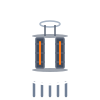
The most-used preamp tube ever made. High mu (~100), lots of gain per stage, slightly bright. The "guitar amp" tube.
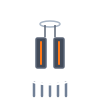
Low gain (mu ~20), high headroom, gentle harmonics. Classic "audiophile preamp" character, never aggressive.
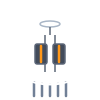
Higher current capability than 12AX7, less gain. Originally a phase splitter / driver tube. Snappy attack, full mids.

Made for driving low impedances. Big rugged sound, lots of headroom, fast transients. The "driver stage" tube.
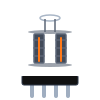
Octal tube from the 1940s. Similar gain to 12AX7 but mellower, with the characteristic "warm haze" of older tubes.
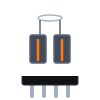
Beloved by Western Electric and McIntosh era hi-fi. Lower gain than 6SL7, very linear, classic "warm" sound.

Premium tube for precision audio. Low noise, high transconductance, very detailed top end. Modern hi-fi staple.
Modern Russian "super tube". Very high current, ultra-low distortion, designed for high-end audio. Punchy and authoritative.
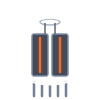
JJ's high-current twin. More like a small power tube than a preamp. Loose bass, big midrange, three-dimensional.